
The second meeting of the Fredericksburg Writers Conference is set for Thursday, June 27th, at the Hill Country University Center, from 6-8 PM. The theme will be CONTESTS. All who are interested in writing are invited, and if you have a story to tell about a writing contest, or have an entry in a current contest, let me know. We will compile a list of local writing contests by the date of the meeting. We will provide ample time for visiting with other writers. You are encouraged to bring books you have written for our display table, and you are welcome to sell books at the meeting.
My submission to the Writer’s League of Texas Manuscript Contest (posted here) has been named one of five finalists in the Thriller/Action-Adventure category. Yahoo! That gets me an invitation to The Writers’ Coffeehouse Welcome Mixer at the 2013 Conference on Friday, June 21, from 5:30 – 7 p.m.
I have never entered a contest like this, and am thrilled at the prospects. Of course, I only have 6,000 words written on this story, and while it has great promise, the hard work remains.
If you have any ideas about where this story should go, please give your opinion.
Robert Deming, Soon To Be Famous Writer
I haven’t written much in the last six months. My characters quit talking to me, or perhaps I haven’t been listening. There are things I am supposed to be doing that I am not doing. After a lifetime of mowing my own lawns I hired a guy to mow one of them because I don’t seem to be doing it myself. I spent all last week in prison, helping guys find a relationship with God, a sort of vacation from reality. I haven’t been working much, but I am not in a financial position to retire. I need some inspiration to get back to work. Real work: making money, putting words on paper, and getting in shape for my next big adventure.
My Toastmasters club, which has absolutely the coolest, most diverse group of people I am around, again provided me with inspiration. Patrick Wilson, a very cool guy from Hye, Texas, has written a book called God’s Law of Attraction. He says that if you set goals, God will help you achieve them. He says that what you think about is what happens. I have heard this before in different contexts, from different sources, from different spiritual mentors. Sounds like it is worth a try. www.jamespatrickwilson.com
My life has been on hold, waiting on my divorce to be finalized. After months of alternating between depression and anger, I sat down with my wife a week ago, and in a loving way we worked out the settlement. I may be giving up more than I have to, but it was the right thing to do, and she and I are friends again. Both of us will move forward with our lives. I will read Patrick’s book, set goals, and move forward. I may even put the goals down here.
Flying from point to point requires lots of small heading changes. Unexpected winds, not holding the correct heading, traffic, all require attention to stay on course to your destination. I used to fly low level navigation training missions with students in the T-38. Typically the route was 22 minutes at 400 mph at 1,000 feet above the ground. For various reasons we would often end up only a couple of hundred feet above the ground, and often went over mountain ridges upside down. It was fun but required close attention. Flying across oceans or the polar icecap at 30,000 feet also required course corrections, but not so frequently or large as at low altitude.
Time for another course correction. One of the characters from Fort Davis Rocks is waiting for me to start listening. This morning I will mow two of those damned lawns. I’m going to get to Enchanted Rock for a walk before Monday. Life is good!
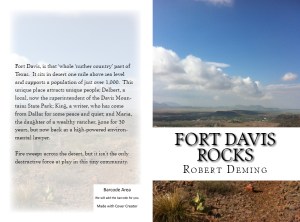
I have never submitted my writing to a contest, but a friend talked me into participating in the Writers League of Texas contest. My entry is a thriller in progress titled Fort Davis Rocks (some of which I have posted earlier on this blog). I have vacationed in Fort Davis for several years. The title refers to the geology of the area – it is high desert, and seems to be mostly rock. Feel free to make comments on this story. The contest requires a short introduction and the first 2500 words; unfortunately, I had to cut off the end of chapter 1.
Introduction
Fort Davis Rocks is a thriller set in Fort Davis, Texas, where the desert lies 5,200 feet above sea level and the population of Jeff Davis County is merely one person per square mile. The only law enforcement of any regular substance is the county sheriff and his four deputies. With only a thousand people in the town, it would seem to the outsider that not much is going on.
This is not the case.
E W is the most powerful man in the county, the president of the bank, and the biggest landowner in the county. His hunger for one particular tract of land is insatiable. The land which would complete his holdings is owned by Delbert, the Texas Parks and Wildlife Park Police Officer at nearby Davis Mountains State Park, who is the only son of a hardscrabble old family. Guinevere is the bartender at the local watering hole, the Limpia Hotel Bar, and Delbert’s on-again, off-again girlfriend. King, the arrogant author of a two national best-selling novels, comes seeking peace and quiet to finish a novel. Maria, a rancher’s daughter who left the area suddenly at age 15 and is now an Austin based trial lawyer, comes to find herself and recover the Blue Mountain Ranch, lost in a shady deal 30 years before.
In less than a week a firestorm will devastate the area, and sleepy Fort Davis will explode.
Fort Davis Rocks: Prologue
Water from the previous night’s rain trickled out of the cedar breaks through very thin soil on top of a continuous layer of limestone. It collected in a depression and ran down the gentle slope, finally cascading over rock smoothed by millennia of trickling water. The rock had been warmed by the August sunshine, and when it finally reached the swimming hole, it was noticeably warmer than the crystal clear water into which it cascaded, with irregular but consistent tinkling sounds. At the edge of the hole an old live oak tree clung to the bank with half of its original root structure, the other half having disappeared when the soil beneath was scoured out by a succession of floods. One root still grasped a piece of limestone it had grown around, and held it out, as if in a hand, or defying the disappearance of the rest of the foundation the tree had once relied on.
At the edge of the pool, which was perhaps twenty feet by forty feet, long, slender, green leaves of bear grass dipped into the glassy surface, like so many Rastafarians with their heads bent toward the water. Above, a knotted rope hung from the upper reaches of the old tree, ready to deliver children into the four foot deep pool. The wind blew loudly through the upper branches of the trees, but at the surface, the air barely moved. Two turkey vultures soared far above, and another swooped down for a closer look, then went on its way. The only sounds beyond the water dripping into the pool and the wind in the treetops were the sounds of wet kisses being shared by the young couple at the upstream end of the pool.
Tiny fish, many only a half inch long, searching for something to eat, finally investigated the hair on Maria’s arm. She pulled her arm out of the water. “They’re biting me!” Delbert, eager to continue kissing the girl, looked down into the water. He, too, had felt the tiny fish nibbling on the hairs on his legs, but he was far too engrossed in the girl to care. She put her mouth back on his, and tasted his tongue again, then abruptly pulled away and threw herself backwards into the water, causing a splash that scattered the fish.
Delbert sat still, watching her through the distortion of the water. Maria surfaced again, facing away from him, and wiggled a little, then turned to face him. She held her white bikini top in one hand, and the bottoms in the other. She had long, black hair, and skin the color of toasted marshmallow. Her substantial young breasts sagged only slightly, and she grinned at him, then turned abruptly and climbed out of the far end of the pool. Delbert watched her supple loins, transfixed by the sight, the first girl he had ever seen unclothed. As she slipped on her sandals and began running up the trail, he swam to the shallow end, where he could climb out, but by the time he got his shoes on, she had disappeared.
The absence of the two fifteen-year old church campers had been noticed, and counselors scoured the area for them. One almost ran into the naked girl on the trail through the oaks. Delbert’s parents could not be immediately located, but Maria’s mother arrived by sunset. By the next evening, Maria was living a cloistered life in a family compound in Matamoros, Mexico.
Fort Davis Rocks, Chapter 1
King looked at the approaching fire with disbelief, if not panic, on his face. An impossibly tall wall of bright yellow flames and grey smoke raced toward him, even as air rushed past him to be consumed by the fiery demon. The fire jumped the road just south of him. He turned and ran north down the center of Highway 17, away from the approaching flames, toward Fort Davis.
A white pickup truck with Texas Parks and Wildlife on the side slid to a stop in front of King. The lights on top were flashing urgently, the horn was blowing. He could see the driver motioning to him, so he went around to the side and climbed in the passenger seat.
The driver put the transmission into reverse and turned the truck around in a U on the highway. “You’re fixing to be a crispy critter there, King.” He put the transmission back in drive and floored the accelerator as the flames reached them.
“I guess I owe you one, Delbert.”
King turned around in time to see his classic 911T Porsche, parked on the dry grass of the highway right of way behind them, begin to burn. After a half mile, Delbert stopped the pickup and put the transmission in park. “Be right back.” He grabbed a pair of fencing pliers from the seat beside him and jumped out, leaving the door open. Beside them, on the land next to the highway, a small Hereford of cows pressed against the fence, bawling. Delbert cut the six strands of barbed wire, starting with the bottom strand. As he got back into the pickup truck the cows poured through the gap and onto the highway.
“That son-of-a-bitch E W don’t give a God damn about anybody ‘cept hisself.”
King looked at him, not understanding. “That’s Earl Wayne Haas’s place. He’d just leave those cows here to burn to death. Nothing deserves that, especially not a cow.” Delbert looked at King. “Not even you. Where you want me to drop you off? I’ve got to get to the park. What the hell you doing back there?”
“Ran out of gas. Coming back from Marfa.”
“Well, that’s a God damned stupid thing to do.”
King shrugged. “Gas station was closed.” They came into Fort Davis. He pointed to the right, to the Limpia Hotel. “This’ll do. Appreciate the lift.”
King stood on the sidewalk as Delbert’s pickup went out of sight up the road to the north. He looked back to the south, where he could see a wall of smoke, but no flames. He shrugged, and walked across the small courtyard and into the bar.
The only people in the bar were the bartender and a busboy. “Maria here?”
The bartender shook his head. “She was here, mebbe half hour ago. Said to tell you to get the fuck outta here.” King grunted. “You want a drink? I’m closing up. Boss told me to go home. The fire, you know.”
“Can you make an old fashioned?”
“Coming up.”
King pulled a ten dollar bill from his wallet and took a seat on a barstool. He played with the bill, folding it in half lengthwise, then in half again, and unfolding it, then folding it again.
“Boss said the fire looks like it’s coming right through town.” He slid the cocktail glass across the bar. King handed him the ten. The bartender held his hand up. “On the house. I closed the register just afore you came in.”
King put the ten down on the bar. “Tip, then. Take it.” The bartender took the bill and stuffed it in his shirt pocket, nodded to him, and left. The busboy went with him.
The bartender turned around in the doorway. “Turn the lights off on your way out.”
*****
One week earlier
King walked into the front entrance of the Limpia Hotel in Fort Davis, Texas with a bit of a swagger in his step. He had never had a half million dollars in his bank account before, the proceeds of an advance on his third novel and the sale of movie rights. The first novel had been ignored until the second garnered a review in the New York Times and the third had been purchased in a bidding war. When he reached the front desk, he pulled an American Express Platinum card out of his wallet and tossed it on the polished mahogany counter.
“Best room in the place. One night for now. Which way to the bar?”
The desk clerk picked up the card and read the name, looking from the card to King and back to the card.
“The bar?”
The clerk pointed to his left. “Outside and across the courtyard.”
“Bags are in the back seat of the car. The Porsche. It’s not locked.”
The only customers in the bar were two older men in faded blue jeans and western shirts. They turned to look at King when he entered the room. With no look of recognition, they returned their attention to each other, and resumed the hushed tones of their private conversation. King went up to the bar. The woman tending bar was of medium height, slender, wearing skinny jeans and a tank top. King noticed right away, as did all men, that she wasn’t wearing a bra, and her substantial breasts tantalized with each movement and the small but obvious point of a nipple showing through the thin cotton fabric. She had very short black hair with streaks of grey, and a sort of chiseled appearance, a narrow waist, and the muscles of an athlete. When she walked around the bar, collecting empty glasses and spent napkins, it was her small but apparently muscular ass that was noticed and often commented on. Her nipples went without comment, but not without more private thoughts.
The bartender focused on King as he made his way around the tables to the bar and took a seat right in the center. He looked at her, waiting for her to ask for his order. She did not speak, but tilted her head slightly to her right. The looked at each other in this fashion, in silence, like it was a game of chicken, and the first to speak lost.
After thirty seconds, King relented. “Do you know how to make an old fashioned?”
The bartender reached under the bar and removed a copy of The Bartender’s Guide, turned to a page near the back, and held it up in front of King.
“Two jiggers of bourbon, two dashes of bitters, a splash of water, teaspoon sugar, cherry, slice of orange. That old fashioned?” She rattled off the recipe without looking at the plastic-covered page, then tilted her head to the right again and raised her right eyebrow at him.
“Make it a double. Top shelf, if you please.”
“Big spender. Haven’t had any of those in here lately.” She turned away to fix the cocktail.
“Business kind of slow?”
“You might say that. You’re not from around here.”
“Just got in. Never been here before.”
“Saw you drive up in that penis extender.”
“That what?”
“The Porsche. 911 Targa. We have a drought on. Ranchers are selling off their cows, hoarding cash. Yeah, business is slow.”
“So how do you know that much about cars?”
“I’m a classic, like your car. And you.”
“How old do you have to be to be considered a classic?”
She slid the drink across the bar. “That’ll be twelve dollars. My friends call me Guin. You can call me Guinevere.”
King pulled a twenty dollar bill out of his wallet and put it on the bar. “Name’s King. Keep the change. You got a boyfriend, Guinevere?”
“More or less. Why you asking?”
“I’m going to be here a while, don’t know a soul. Thought maybe you could show me around.”
“Well, it’s mighty nice of you to suggest that. At the moment the boyfriend is more, rather than less, but that changes from time to time. I should warn you he carries a gun.”
“I see. And who is this vacillating vaquero?” King was proud of such a clever phrase, produced within the rhythm of the conversation, and grinned.
“Those are mighty big words. You’re about to meet him. He’s coming through that door in about ten seconds.”
King turned toward the door. The man who came through the doorway was about six feet tall, lean, and weathered. He was, indeed, carrying a gun on his hip, and was dressed in a short sleeved khaki uniform shirt and dark green pants with a badge over his left shirt pocket. He removed a dark green ball cap as he entered the room, revealing short, dark hair with streaks of grey. He nodded to the two older men at the table, walked up to the bar, and sat down at the first bar stool.
He spoke to Guin. “Feels good in here. Looks like summer’s here early.”
Guin didn’t smile, but looked at him intensely. He suddenly reached across the bar, grabbed one of the obvious nipples between his thumb and forefinger, and tweaked it. Without hesitation, Guin reached out with her right hand and slapped the man hard on his left cheek. His head turned with the force of the blow, but he didn’t flinch.
“Nice to see you, too.”
Guin pointed to King. “This here’s King. He’s the newest drifter in town. Only been here five minutes and already tried to pick me up.”
“Did he get anywhere?”
“Might have if you hadn’t showed up. He’s driving a classic Porsche Targa.”
“What’s that got on a 78 Ford Ranger?”
Guin shook her head slowly. “Well, the air conditioning probably works.”
The man shrugged. “It’s a classic.”
“You men are all classics. Well, I’m working until 9 tonight anyway. I warned him that you’re packing heat.”
“Packing heat, uh? You reading those detective novels again?”
To that, Guin smiled. She turned to her left. “King, this is my vacillating vaquero. His name is Delbert, but I call him Del.”
Delbert reached out with his right hand towards King, who responded by reaching out with his right, and they shook hands. King squeezed the offered hand hard, a technique designed to intimidate, but he found the muscled hand and arm resisted his force. Delbert’s face showed nothing except the red mark of Guin’s right hand.
“What did you say I was? A vacill what?”
“Vacillating vaquero. His words.”
“I suppose. Pick you up at 9:00? Dinner at my place?”
“TV dinners again?” She slid a glass of ice and Coke across the bar to Delbert.
“Not today. Picked up some fine little tenderloins from Stone Village Market. Randall tried to give them to me. I think he’s trying to bribe me. For what, I don’t know.”
“You think a tenderloin might get you somewhere?”
Delbert raised his eyebrows. “Might oughter,” then he swiveled the barstool to his right to face King. “What brings you to this godforsaken corner of the desert?”
“Wide open spaces. One person per square mile. I came for the peace and quiet. I’m a writer. Got a big project due in a month. Needed to eliminate distractions.”
“You going to be here a whole month? Most people don’t make it that long out here.”
“That’s my plan. What about you? Why ‘r you here?”
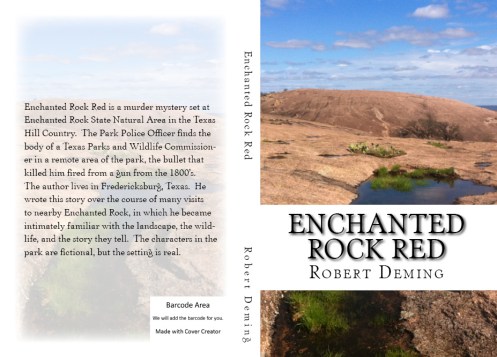
Chapter 1
The Fire Burns Out
Maurice Neunhoffer stood in a circle of 13 men and 2 women near the entrance to Enchanted Rock State Natural Area, 17 miles north of Fredericksburg, Texas. The Fire Boss was reviewing the day. They all wore yellow shirts and green pants made of Nomex identifying them as firefighters. The golden light of the setting sun made the colors richer and added to the drama of the moment. All of them were tired, some near exhaustion, and they were grimy with ash and the residue of smoke. A few feet away flames flickered on the trunk of an old mesquite tree, dead for years, one of the targets of the controlled burn. Maurice was not listening; he had heard this drill before. He was thinking about the folded envelope in his pocket and its implications for his future. Seventy seven miles away (as the crow flies) in south Austin, the woman who penned the note touched her wine glass to another, celebrating the successful transition she had made over the last two days; a new city, new job, new place to live, new boyfriend.
The meeting ended and the firefighters climbed into their cars and pickup trucks even as the cars and pickups of the day’s last few park visitors lined up at the entrance station. Maurice stood by himself.
“You coming, Maurice?” Two men he had worked closely with during the long day looked at him from the open window of a pickup painted in the forest green of Texas Parks and Wildlife.
“Nah, I’m going to hang out here for a while.”
“Machts gut.” The men shook their heads and turned away, their thoughts already on beer, chips, salsa, and beef enchiladas at the Enchanted Inn back towards Fredericksburg.
Maurice walked slowly to his pickup after the last of the firefighters were gone. He didn’t have anyone to go home to. He didn’t even have a home to go home to. He pulled the envelope out of his pocket, removed the hand-written note inside, and read it again. He camped at the park the night before because of the early start for the controlled burn, and had found the note under the windshield wiper on his pickup earlier in the day as he sat in the cab eating his brown bag lunch.
“It’s over, it’s been over for a while, we both know that. I don’t have any bad feelings. Your stuff is in number 1329 at Tivydale Business Park. The combination to the lock is your birthday. I have a new position in Austin teaching reading, which you know I’ve always wanted to do. I moved out of the apartment and turned the key in. You’ll be fine. I will too.” It was signed in the familiar looping script with a little heart over the “i” in Tina.
He thought about burning the letter in the remains of the fire, but decided it wasn’t worth the effort. Besides, he might need to refer to it again for the number of the storage unit. He had packed up his tent and camping gear early that morning and it was all still in the back of his pickup. Many of the other firefighters had stayed in the bunkhouse, Maurice had spent the night in the campground. He liked the solitude. He would rather sleep on the ground anyway. Tina never understood that side of him. She wanted things from him he couldn’t give; a room in a nice hotel, dinner at a fancy restaurant, emotion. Even now, with nowhere to go, no one to go home to, Maurice didn’t feel much. He hadn’t really felt much in a long time. He started the engine and drove to the campground, parking in front of the bathrooms. All around him people were cooking camp food, setting up tents, rolling out sleeping bags. He could see at least three different Boy Scout units, numerous 20-somethings, a few families. He couldn’t see an empty campsite. What he needed most was a shower. He got together his shower kit and a change of clothes and a towel and went inside.
When he emerged clean but wearing yesterday’s jeans and t-shirt, he looked around the camping area – there were some places he could pitch his tent, but there were people everywhere. The sun was low on the horizon, about to slip behind a ridge of pink rock. He opened the locked toolbox on the back of his pickup, got his Kelty backpack, and stuffed it with some essential overnight gear and the rest of the food he had brought yesterday. Inside the toolbox were also a clean Parks and Wildlife uniform, a gun belt, and a badge. He was the law enforcement ranger on duty in the morning. He would drive the pickup marked “State Park Police” on the side, keeping an eye on the visitors. He only wore the gun belt if he was expecting a visit from his supervisor, who emerged from Headquarters in south Austin every now and then to check on him. Weekends were very, very busy, and the crowds often reached the capacity of the park to absorb them. With that many people there were always problems, sometimes related to the consumption of alcohol, sometimes simply unleashed dogs, or lost hikers. Some of the law enforcement rangers he knew liked the work, relished exercising their authority, wearing the gun and the badge. Maurice worked law enforcement because had to; it paid better than being a ranger and there were not enough hours doing the other jobs at the park to keep him employed full time. He was a licensed peace officer, the certificate a remnant of ten years as a police officer in Fredericksburg. He had found that career not to his liking. His job title was PPO, Park Police Officer, but he preferred to think of himself as a Park Ranger. He had read somewhere that the job was, “protecting the people from the resource, protecting the resource from the people, and protecting the people from each other.” He hefted the pack on to his back and walked along the road towards the Loop Trail. He knew that if he walked closer by some of the campsites later in the evening he would detect the odor of burning hemp and that he could easily make a bust for possession of marijuana. He did not care if they got high sitting around a campfire. They did not cause trouble and did not drive. Besides, if it was a felony he ended up testifying to the grand jury in Fredericksburg, which was time consuming. Live and let live, that was his motto. Let them have their fun. He got to the end of the pavement and headed down the trail. It was not his responsibility tonight.
The park had three designated backcountry camping areas. Maurice knew the park intimately, including some beautiful camping places that were not strictly within the designated primitive camping areas. His presence in the backcountry, such as it was in a park of 1664 acres, was a part of his job, and sometimes he would spend the night in one of those places. He was always very careful to leave no trace. These special places renewed his spirit, helped him hang on, and gave him the enthusiasm to be positive and friendly with the large numbers of people he saw every day. The hike was about 20 minutes. He approached the place quietly; often there were deer drinking from the creek in the evening. The sun was below the horizon as he carefully picked his way over the rocks to a little glade of sorts – a wall of stacked boulders keeping it out of view from the trail, a pool of water, and a gravel beach to lay his sleeping bag on. He sat down on the gravel beside his pack, and then looked up at the sky. No chance of rain. He unrolled his pad, pulled his sleeping bag out of its stuff sack, and laid it all out. Then he found his “Pocket Rocket” and put together the little propane stove. He took a drinking cup out of his pack and measured 1½ cups of water from the clear pool, put it in a beat up aluminum pot, and started heating it to a boil. Because the water was unfiltered, he boiled it for a couple of minutes, just to be sure. Too many people out here. He rummaged through his food bag until he found a pouch of freeze-dried food – Mountain House Lasagna. He carried a few of these meals in his pickup in anticipation of nights like this. He sometimes had to work law enforcement at other parks in the Hill Country, and he usually camped. Winter or summer, hot or cold, wet or dry, he preferred the solitude of the camp to the depressing atmosphere of motels or the blandness of park housing.
Clean and full of lasagna, he got into his mummy bag, moving the gravel bed beneath him a little here and there to get it just right. The Milky Way and its billions of stars were clearly displayed above him. He thought of a song he had learned as a child, “The stars are big, the stars are bright, deep in the heart of Texas.” He thought about Tina, hoped she was doing well. He knew he had not been much of a companion for her, was glad they had not gotten married after all. Deep inside he had known they were finished. She had not gone camping with him in a long while, or floated the rivers beside him in a kayak. She had just moved to Fredericksburg the year before, at the end of the school year, and he had met her, coincidentally, on her first night in town, at Hondo’s on Main. They had danced the two-step, moved in together; a year later, she danced back out of his life. He had hoped she would heal his wounded heart. She was pretty, vibrant; a bleached-blonde brunette, an elementary school teacher. She was just what he needed. Somehow, it had not worked out; she had not healed his brokenness or filled his emptiness. Maybe he had become more distant? It was very quiet around him, just the rustle of a breeze through the trees. He smelled something odd in the air, just a hint of something. He wondered if there was the carcass of a dead animal nearby. Then he heard a loud snort, and turned slowly to see a buck deer silhouetted in the moonlight. He lay very still and quiet. The buck walked slowly, cautiously, towards the water, twenty feet away, watching him for signs of movement. Maurice counted the antler points – eight, maybe ten. A nice trophy, but not for him, for his live-and-let-live policy extended to deer. The deer took a long drink from the pool, Maurice shifted slightly, and the buck suddenly sprang up and ran away.
He rolled over and fell asleep, dreaming of deer, smoke, and fire.
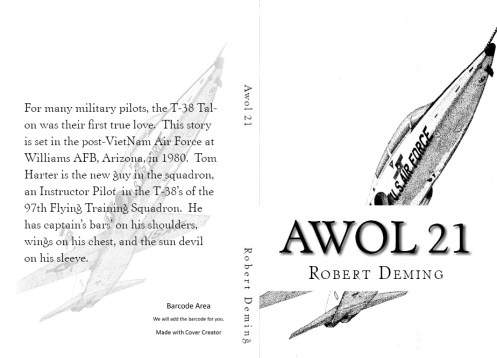
After some test readers commented on my novel Awol 21, I have been writing a new final chapter. I was stuck for a month, couldn’t write the first sentence, until today. Now I know what that final chapter is, and it’s perfect. I have aquired the right to use the cover art work, and should have this project wrapped up and for sale in two weeks.
If you are or ever were a military aviator, you will enjoy this unique story. If not, you might not understand everything, but the life the story portrays is authentic, and you will enjoy the ride. Coming to you soon, via Amazon, Kindle, and Nook.
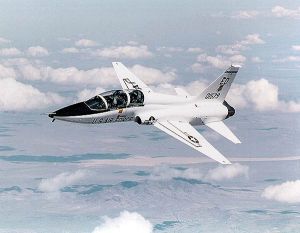
We called her the white rocket, and for many of us, she was our first true love. She was sleek, sexy, and fast. When you climbed the ladder into her cockpit, wearing a flight suit, g-suit, parachute, and helmet, and strapped into her, you were tense with apprehension, sweaty with fear, brain buzzing with procedures, excited with anticipation. We also privately called her a bitch and a whore, because she could kill you, too. When you rolled her over on her back and pulled her nose down and shoved her throttles into afterburner, you’d be supersonic in a couple of seconds. As we said, she flew like a bat out of hell.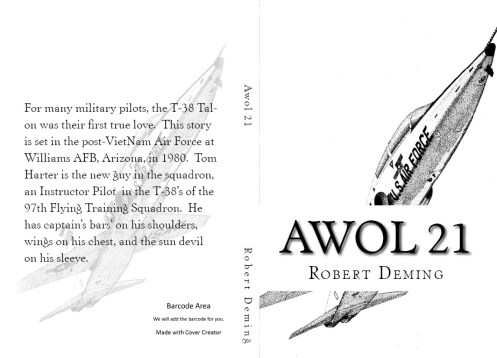
We called her the white rocket, and for many of us, she was our first true love. She was sleek, sexy, and fast. When you climbed the ladder into her cockpit, wearing a flight suit, g-suit, parachute, and helmet, and strapped into her, you were tense with apprehension, sweaty with fear, brain buzzing with procedures, excited with anticipation. We also privately called her a bitch and a whore, because she could kill you, too, and she did kill some friends of mine. When you rolled her over on her back and pulled her nose down, and shoved her throttles into afterburner, you’d be supersonic in a couple of seconds. As we said, she flew like a bat out of hell.
AWOL 21 is a story about that love affair. I posted the first chapter under Bits and PIeces. As far as I can tell, this is the only story of its kind. I’ve re-written it so many times, I’m not sure I can do it again. Some of it might not make sense to someone who isn’t a pilot, but that’s OK. It didn’t make any sense at the time, either.
Awol 21
They were at 500 knots on their way to vertical, climbing into Arizona’s endless burning blue sky, in the start of a loop, with a solo student 1,000 feet behind them in extended trail, when Tom heard a familiar voice on the radio.
“Albuquerque Center, Awol 21, I have an emergency.”
The voice was a little high pitched and conveyed a sense of urgency, even fear. Tom, in the back seat of the T-38, had been turned around in his ejection seat to check their wingman’s position, when the student flying the jet from the front seat abruptly pulled the stick back to a 5 G acceleration without warning him, and he hadn’t been ready for it. He couldn’t turn back around to face forward with this much G and found himself jammed in an uncomfortable position with his right hand on the glare shield in front of him and his shoulders and neck twisted to the left. The g-suit around his legs and lower torso inflated too late to stop blood from draining from his head and pooling in his legs. First, his vision turned to black and white, then he lost his peripheral vision, then it was black. By the time the jet reached vertical the G’s came off completely and the blood slowly returned to his head.
Tom heard Albuquerque Center’s reply as his vision returned. “Awol 21, Albuquerque Center, what is the nature of your emergency?” Tom could now see that the wingman had maintained the proper position above and behind them, so he turned back around to face forward.
“Albuquerque, Awol 21, I have an engine fire warning light. Request return to base.”
They were now wings level inverted at the top of the loop. Tom moved his head a little left to right and back to see if he had a pulled muscle in his neck; it seemed ok. The last time that happened he had a stiff neck for days. As they began to nose down through the horizon inverted Tom said to his student, “Roll out to wings level,” so the student converted the loop into an Immelman and rolled awkwardly into an upright position. Tom knew his wingman would have trouble following this maneuver at such a slow speed, but he was far enough back that he could figure it out.
“Awol 21, Albuquerque, cleared direct Williams. Do you need any assistance?”
An engine fire in flight was unusual.
“Yeah, could you give me a vector? I’m not receiving the TACAN.”
Uh-oh, sounds like a solo student.
“Awol 21, Albuquerque, turn heading two-five-zero.”
The voice sounded like a student in his flight. Tom was new at instructing and wasn’t sure what to do. They had a lot to accomplish on this flight and had just started in the practice area, but no other instructors had checked in, so Tom decided he must be the only IP one in the areas on this frequency, and had better see if he could help. “Awol 21, this is Awol 26, are you solo?”
“That’s affirmative, sir.”
“Albuquerque Center, Awol 26, Where is Awol 21?”
“Uh, Awol 26, 21’s in Apache Low. You have an instructor on board?” His flight was in Navajo Low, which was the adjoining practice area, about 70 miles east of Williams AFB.
“Albuquerque, Awol 26, roger that, I’m going to join on 21, give me a vector please.”
“Roger, Awol 26, he’s at your 10 o’clock at 12,000 feet, about 10 miles. You’re cleared all the way to join him.” Awol 26 was at 22,000 feet, slightly nose down, full power, pretty slow at 250 KIAS but accelerating. Tom turned to see his solo wingman 1,000 feet back and slightly above.
“Johnson, do you think you can find 21 and join on him?” he asked the student pilot in the front seat.
“Affirmative.”
”Go get him.”
“Awol 26 – 2, go tactical.”
“Two”.
Johnson pushed the nose down as he eased the throttles into afterburner, then turned left 20 degrees Their wingman moved out to tactical, a mile out and above.
“Awol 21, what is your situation?”
“I had a fire warning light on number one and I shut it down.”
“What’s your name, Awol 21?”
“Dave Smith, sir.”
“OK, Smith, this is Capt. Harter. We’re a flight of two, requesting permission to join on you.”
“Yes sir, permission granted.”
“And Smith, if you get any indications that there is actually a fire out of control, you’re going to bailout.”
“Yes, sir.”
“Awol 21, what’s your indicated?”
“Uh, three-ten.”
“Did you run through the engine fire in flight checklist?”
“Affirmative.”
“When we catch up with you we’ll review single engine landing procedures.”
“Yes sir.”
Tom could see their wingman, Lt. Jones, in position a mile out to the left and 1,000 feet above, just where he was supposed to be, in position to clear for them but not be in the way. They were now indicating 550 knots, the throttles back to military to keep them from going supersonic.
“Awol 26 flight, Albuquerque Center, Awol 21’s 12 o’clock and 5 miles.”
“26, Roger.”
The sky was a typical summer blue from horizon to horizon. Although they were almost supersonic now, with smooth air and no clouds to frame their movement it seemed that they were suspended there, high above the earth. Four miles below the desert floor baked in the midday sun; the high altitude cold made the heat irrelevant to them.
Tom called Albuquerque Center, “I’m going to be off frequency for a minute.”
“Roger 26, report back.”
He turned the radio to channel 5, the RSU. The RSU (Runway Supervisory Unit) was a small building that looked like the top of a control tower sitting beside the touchdown zone of the runway. Inside were two instructor pilots and two student pilots controlling traffic in the T-38 overhead pattern on the outside runway. RSU was also in charge of in-flight emergencies. “Ace Control, this is Awol 26.”
“26 go ahead.”
“Awol 21 solo is leaving Apache Low with number 1 shut down and a fire warning light on. I’m about to join on him.”
“Roger 26. Need any help?”
“Negative. Will call you back after I can look him over.”
“Roger. I’ll get the fire trucks out here and I’ll listen in on Approach.”
“26.” Tom switched the radio back to channel 10, Albuquerque Center. “Albuquerque, Awol 26, back your freq.”
“Roger 26, 21 is at your 12 o’clock 3 miles.”
“26.”
Tom called to the solo, “Awol 21, this is Awol 26. Give us a wing flash.” Awol 21 rocked his wings, making a highly visible a flash of white against the bright blue sky.
“I’ve got him!” Johnson called out. “He’s a little below on the right.” Tom looked out the right side of the cockpit and saw the lone T-38.
“Got him. Good job.” “Awol 26-2, do you see him?”
“Roger”
“Keep us both in sight. Stay in tactical until we get to initial.”
“Yes sir.”
Johnson turned the jet further right and pushed the nose down a little more, “I’ll join on his left wing sir, if that’s alright.”
“Affirmative.”
The students were the junior class and Tom thought they were handling this well. They closed quickly. “Better slow this baby down” . Johnson pulled the throttles to idle and opened the speed brakes. The wingman shot ahead of the flight, but turned away and started s-turning to drop back into position. They two jets were closing very fast now. “Don’t overshoot any farther than you have to,” Tom told the student. “G it up, a quick, hard pull, after you pass him.” Lt Johnson did just that; after he passed under Awol 21, still with a lot of overtake, he shot wide, made a high G turn back towards the jet they were joining. The turn dissipated a lot of energy, and they quickly found themselves at 300 knots about 100 feet out on his left wing. “Bring us up to fingertip,” Tom told Johnson.
“I don’t see anything,” Tom called to Awol 21. “We’re going to cross under and look at the other side.”
“Roger.”
They closely examined the exterior of the T-38 but did not see anything out of place. “You look good from here.”
Tom looked up to the left and saw the wingman still out in tactical formation. Tom called to the wingman. “Awol 21 dash 3, when we get back to the field I want you to leave the formation and go into the overhead pattern. We’ll be making a straight in on the center runway. You can stay in the pattern if you like.”
“Yes, sir.”
“Lt Smith, is the fire warning light on?” Tom asked.
“Negative, no light.”
“What does the EGT for the left engine show?” Tom asked.
“No EGT.”
“I think you’re OK. Do a straight in to the center runway. We’ll follow you down to the flare, then go around. Any questions?”
“No questions, sir.”
Tom radioed Center; “Albuquerque Center, Awol 21, flight of three.”
“Albuquerque, go ahead.” “Albuquerque, 21-2, we’re going to do the standard[r1] arrival for a straight in runway 30 Center.”
The arrival was routine except that it was unusual to have a flight of three. When the flight turned on a 10 mile final for Runway 30 Tom called the wingman to join in to fingertip formation on the left wing, as there wasn’t enough space in the pattern for him to be in tactical. ABQ sent them to Tower.
“Awol 21 flight, go button 2.” He heard “2,” and “3.” Smith then checked the flight in on Channel 2. “Williams Tower, Awol 21 flight of three, 10 mile final for a straight in.”
“OK, Awol 21, do you need any assistance?”
“Negative.” Tom came back on; “Awol 21 lead, review single engine landing and go around procedures, that’s on page E-13.”
“Yes sir.”
Tom could see Smith’s head go down as he looked over his checklist for the emergency procedures, but he kept reasonably good control of the airplane. The runway was coming up now, 3 miles out, and lead gave the hand signal to lower landing gear. Tom called to the solo wingman, “Awol 21 dash 3, cleared to leave the formation, go button 5 and enter initial for 30 Right.” Jones acknowledged and dropped back and out of sight. Tom could hear and feel the solid thump of the landing gear locking into place.
Ahead they could make out a red fire truck parked on the taxiway at the runway’s midpoint, and another pulling into position at the far end of the runway. Tom visualized the four firemen inside each truck, each wearing the heavy silver heat-resistant rescue suit. If there was a crash the fire truck would approach the burning airplane spraying foam from the nozzles over the cab, then two firemen in the silver suits would climb out of the trucks and walk into the fire. Black smoke from the burning jet fuel would fill the sky as the trucks converged on the fire, still spraying fire retarding foam from the high pressure nozzles. Soon, if all went well, the firemen would come out of the smoke carrying the pilot. Tom shook the thought out of his head.
Soon they were on short final, with gear down and flaps at 60%. Tom glanced inside the cockpit to check the airspeed, and then looked back out at lead, three feet beyond their right wingtip. 175 KIAS. Just right. Suddenly movement at 10 o’clock caught his eye, and his head automatically snapped to the left. There was a T-37 in front of them to the left in a steep left bank, gear and flaps down, belly up to them, at their altitude, only a few hundred feet away and closing fast. It appeared that the T-37 had been in left turn to final for the inside runway and overshot. Johnson, in the front seat, was concentrating all his attention on lead and staying in position and apparently didn’t see the T-37.
A frantic “Final go around, final go around” came over the radio on Guard from the center runway RSU controller. Tom could see the faint blue glow of the afterburner lighting on Awol 21 as he started turning right, away from the T-37. He grabbed the control stick and slammed the throttles into afterburner, then threw the gear and flap levers up.
“My airplane.”
“The student reflexively held his hands up and said “Your airplane”. Tom started a left turn and pulled the nose up simultaneously. He figured they had 100 knots of overtake on the T-37, and had about 2 seconds to get out of his way. “Can you see the T-37?”
“Yes sir, I have him.”
“Where is he?”
“He’s below us on the right.”
Tom said, “You have the airplane.” The front-seater shook the stick to indicate he had the controls. Awol 21 was on their right and had his gear and flaps coming up, but with only one engine, he wouldn’t be able to maneuver as well as they could and Tom wanted to give him room. He could see the T-37 now, several hundred feet behind them. The runway was below them now; they would have to make another pattern. “Keep us in route,” he told the student. “Give him some room.” They stayed 100 feet off Awol 21’s left wing and slightly behind him. “Awol 21 lets go to Phoenix get vectors for another straight in.”
“Roger,”Awol 21 flight, go button 3.” Tom could see his other student in the pitchout for the outside runway now. With the one engine in afterburner and gear and flaps up, Awol 21 was soon back to 280 KIAS and climbing. Lead checked them in on the radio and asked Departure for vectors for a straight in to the center runway.
“You the emergency?” Phoenix Departure Control asked.
“Roger, we’re a flight of two; lead has an engine shut down.”
Phoenix turned the flight right onto a crosswind. “Awol 21, what’s your fuel?” Tom asked.
“1200 pounds, sir.”
“Good job back there. Keep your cool now.”
“Roger”.
The rest of the pattern was uneventful, and might as well have been just another single engine straight-in practice. Awol 21 stayed in route formation on the downwind and final. They checked lead’s gear and flaps down, and watched him fly a beautiful straight in landing. As the solo lead flared out, 2 went around: throttles to Military, nose up, gear and flaps up. They switched to Channel 5, Ace Control: “Awol 21-2, Center, request right closed traffic for 30R.” Tom looked to his right; there was an airplane on the inside downwind, but otherwise the pattern appeared clear. Down below he could see the solo lead in the landing rollout. The fire truck at the end of the runway was still in place, and he could see Safety’s blue Ford pickup there, too. He sat back and relaxed as they got clearance for a closed pattern. They rolled into a 60 degree right bank and pulled up aggressively into the closed pattern, and in a minute or so were on the runway, rolling out.
Back in the squadron parachute shop Tom ran into Major Thompson, the Squadron Operations Officer. “What happened, Tom?” he asked. Tom told him about the rendezvous and the excitement on final with the overshooting T-37. “They called over here,” he said when Tom was finished. That was an initial solo. The RSU said you were so close they thought you were all goners. Cheated death one more time, eh?” Tom smiled as he hung his parachute and helmet up on their pegs and unzipped his g-suit. Thompson was putting on his g-suit. “From what I heard you handled it pretty well, too. Keep up the good work.”
Tom was surprised, and it showed. “Thank you, sir.”
“Best damned job in the world,” Thompson said, grinning, slung his parachute over his shoulder, and headed out the door towards the flight line, student following.
Lt. Smith was in the flight room when Tom got there, surrounded by his classmates, his hands in the usual “there I was” pose. “Dave,” Tom said, and they all turned to look at him.
“Yes sir, Captain Harter,” he replied.
“Where’s your grade sheet?” he asked. He looked confused for a second, then opened the folder on his desk and handed Tom a Scantron form. Tom took a pencil from his sleeve pocket and went down to line 34, “Emergency Procedures.” He marked the “E” block, for Excellent, and handed it back to him, saying, “Good job, Lieutenant.” Smith smiled, then came to attention and saluted .
“Thank you, sir.”
The IP saluted back, then turned and went to his desk. Both of his students came to the desk and took their places. “Any questions?” he asked. “You both did well, and I’m going to be proud to see you pin those wings on in a couple of months,” “Now give me those grade sheets. You know what they say?” They both looked at him but didn’t say anything. Tom smiled. “The mission’s not over until the paperwork’s complete.”
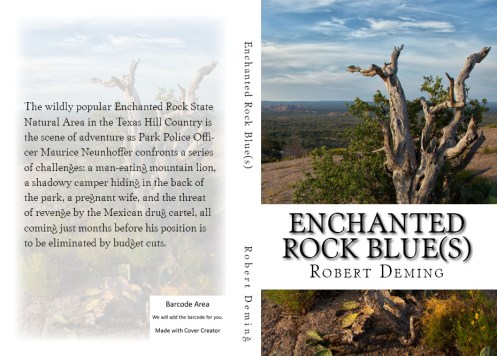
Maurice Neunhoffer stood alone on the top of the knob shown as a scenic view point on the folded map of Enchanted Rock State Natural Area in his left shirt pocket. Above the pocket was the badge of a Texas Parks and Wildlife Park Police Officer. He faced the western horizon, where a cumulonimbus cloud spat out lightning and rain a few miles away. Over his shoulder an AR-15 rifle hung from a strap. A hundred yards behind him on the Loop Trail a John Deere Gator stood empty. The towering storm cloud blocked the late afternoon sun. High above a lone vulture circled, canvassing the terrain below for a meal. Maurice held binoculars to his eyes, moving them slowly to the right as he examined the terrain between his position and the western boundary fence. He continued turning to the right until several minutes had elapsed and he had turned a full 360 degrees. The remains of a picnic were scattered around at his feet. He bent over and collected the scraps of food, an empty green bottle lying on its side by the stain of spilled wine, a daypack, and a picnic blanket, and walked back to the Gator.
The trip back around the Loop Trail to Park Headquarters would be half an hour on foot, but in the Gator it was only ten minutes. When he arrived he saw the green pickup truck of a Texas Parks and Wildlife Game Warden in the parking lot. In the distance he could hear the blades of an approaching helicopter beating the air in a frenzy of ‘whop-whop-whop.’ Maurice slipped through the door beside the entrance drive where Becky stood ready to collect user fees.
“Any luck?”
“Nah.” Maurice continued towards the back office. In the office the Game Warden sat in a chair beside the desk, the Park Superintendent behind the desk. Maurice smiled when he saw who had come in the green pickup outside. “Wie gehts?”
“Sehr gut.”
Maurice shook the Game Warden’s hand, nodded to the Superintendent, then took off his cap and sat down in the other office chair. “Nothing. Nada. How’s the victim?”
The Superintendent shifted in his chair. “Not too bad. Had some stitches at the ER in Fredericksburg.”
“Sounds like you’re going to be on TV tonight.”
The Superintendent shook his head glumly as the helicopter with the logo of an Austin TV station on the side slowly settled onto the grass behind the building. “What are we going to do about it?”
Max, the game warden, spoke up. “They’ve got a pretty big range. He could be watching the campground from one of those rocks behind us or he could be miles away and never coming back.”
“All the same, I think we should close the Loop Trail.”
Maurice sat up straight in his chair. “And the Walnut Springs and Moss Lake Campgrounds too? There’s a bunch of campers out there. Where we going to put all those people?”
“Got to do something. If that cat attacks someone else, there’ll be hell to pay. Max, what do you think?”
“Attacks by mountain lions are rare. We’ve got some public information handouts on mountain lions. Tells you how to prevent an attack, what to do, that kind of stuff. They’re on our website. We can pass them around and warn people to be on the lookout.”
“How about you guys spending the night out there? Aren’t they nocturnal? Maybe you’d see it then.”
Max looked at Maurice. “Hell, I don’t know. I suppose that would be OK. Maurice, you up for a camp-out?”
“You know me; I’d live in a tent if Angela would let me. She’s in Houston with her parents for a few days. How ‘bout you get your camping stuff and some grub and meet me out by Walnut Springs?”
“I suppose so. You’re going to have to tell me where that is. It’ll take me a couple of hours. What happened to that storm?”
Maurice got up and looked out the window. “Looks like it’s moving off to the north. Bring a couple of those big spotlights with you. I’ll get my stuff together and get some brochures passed out.” They could hear the TV reporter in the lobby. He turned to the Superintendent. “Looks like you got your work cut out for you. I’d face down a mountain lion rather than those cameras any day. I’ll get some of those brochures, and then I’m outta here.” He stuck his head out of the office door; Gwen was only a couple of feet away at a station registering guests. “Are there any campers in Buzzard’s Roost Campground?”
“Two.”
“I’ll get out to the campgrounds and pass the info out ASAP.” He took the folded park map out of his shirt pocket and made an X in the Walnut Springs Primitive Camping Area, then handed it to Max. “Here’s where I’ll be. Bring some decent food, eh?”
While Gwen printed two hundred of the Mountain Lions In Texas brochures from the TPWD website, Maurice slipped out the back door with the AR-15 over his shoulder and drove the Gator to his living quarters at the north end of the park along the highway. He got his sleeping bag, sleeping pad, and tent, filled a big jug with water, grabbed his field jacket, and drove back to the Headquarters. The TV camera was set up on the back deck, and the Superintendent was being interviewed by a reporter with long, curly, brown hair. Maurice quietly went in through the side door. Gwen handed him a couple of manila envelopes filled with the two page brochures.
“That reporter asked about you. “She said she was hoping to get you on film for the evening news.” Maurice grimaced. “I told her you were out chasing the big cat.”
“Thanks.” Maurice smiled, tipped his hat to her, and then slipped back out the side door.
Maurice started by driving out the highway to the entrance for the Buzzard’s Roost Primitive Camping Area. He only found two campers there, gave them each a brochure, and then drove back to the main camping area as quickly as he could. He began by duct-taping a brochure to each of the doors of the campground bathroom. Then he walked around the campground talking to people and passing out brochures. By the time he was finished the sun was approaching the horizon, and several more thunderstorms were visible in the western sky. He got in the Gator and drove the Loop Trail clockwise, first to the Moss Lake Primitive Camping Area. He expected that spreading the information around these backcountry camping areas would be easier than it sounded, as they were occupied primarily by Boy Scouts.
“Hey, there. How are you?”
A bedraggled Boy Scout with a dirty face looked up at him from the Loop Trail. “Freakin’ tired. We had to climb up that rock all day long.”
“I’ve always wanted to say this: take me to your leader.” He laughed. The boy looked at him, not comprehending. “Climb in, let’s go find your scoutmaster.”
The boy got in beside him and they drove into the camping area until they found a dozen tents in a semicircle and two men sitting on the trunk of a fallen tree. The boy identified the men as his scoutmasters. Maurice explained the situation to them and gave them several of the brochures. Then he drove the Gator back to the Walnut Springs area and found the Scoutmaster there. He had already heard about the mountain lion attack.
“Do you think it’s safe to be out here?”
“Attacks like that are rare. I’m going to be out here all night with the game warden. We’ll be camped another few yards down the trail. Pass these around to your boys.” He handed the scoutmaster a stack of brochures. “If you see a mountain lion come look us up.”
A couple of hundred feet past the Scouts’ camp, Maurice turned the Gator left off the trail into a small clearing. Behind him was a drainage which occasionally held water; in front of him, a campsite shaded by a large tree. A storm rumbled and flashed to the southwest. Maurice set up his tent and put his sleeping bag inside. Daylight was fading fast. He could see headlights approaching through the campground, so he walked back into the campground area until he found Max, then drove with him back to the campsite.
Max put up his tent while Maurice set up the Coleman propane stove on the tailgate of the pickup. The stove had a grill on the right and a burner on the left. He pulled the ice chest in the bed of the truck towards him and opened it. In the ice were six plastic bottles of tea and a couple of packages wrapped in white butcher paper. He held the larger package up towards Max with a questioning look.
“T-bones from Dutchman’s.”
Maurice grinned. “I owe you, man. This is living.”
“There’s some jalapeno poppers in there, too. They had just made a batch so I picked up a couple dozen. Why don’t you get those going first?”
“Damn. I hope your wife doesn’t mind you coming out here tonight.”
“Nah. She’s going out to dinner with our small group from the church.”
“I’m sorry I made you miss it.”
“Are you kidding? This is the part of my job I love. The rest of it gets old. What happened to your buddy John?”
“Gone to New York. His book just got published. He’s doing promotional stuff. He’s supposed to be on the Today show. They say it’s going to hit the New York Times Best Sellers list. Back in a week.”
“He’s coming back to work as the custodian?”
“Says he has too much fun here to give it up.”
“I know what you mean.”
“You think we have any chance of finding this cougar?”
“Nope.” Max got a couple of folding chairs out of the back of the pickup and set them up by the tailgate, opened a bottle of iced tea, and sat down. “I’ve been here twelve years, been pretty much everywhere at day and at night, and I’ve never seen one. I’ve investigated several sightings or killings, but never laid eyes on a live one.”
“Me neither.”
“I say we eat supper, then take the spotlights and just wander around for a while. It’ll sound good in my report. From the looks of things there might be a storm coming, then we can give it up and get some sleep.”
“You’ve seen a dead one?”
“Saw one up in Llano County last year. Don’t know what happened to it, but from the wear on his teeth he was at least ten years old. Beautiful animal. About 150 pounds. I’d like to catch a glimpse of one sometime. They’re just damned hard to find.”
Maurice put the now-cooked, bacon-wrapped, cream cheese stuffed jalapenos on a paper plate and set the steaks on the grill. “What do you suppose we’ll have to do if this cat attacks someone else?”
“We can set up a trap. That might work. If that doesn’t get him we may have to bring in a professional hunter with lion dogs. I sure as hell hope it doesn’t come to that. Maybe get the DPS to bring a helicopter over. Shooting wild animals from a helicopter just ain’t right, but that might be the only way to get him. You’d have to close the park while we were hunting him. Problem is, if this cat’s decided people’s easier prey than deer, he might try it again.”
“Yeah, look at it from his point of view. He just lays around in the shade by the trail and big soft meaty things come walking by. Good thing his victim was in pretty good shape. The girl with him said her boyfriend fought like hell until the cat left. Someone out here by themselves might not be so lucky.”
Maurice turned the steaks over. “How about tracks? Cougars leave any sign?”
“Lots. Parks and Wildlife has a good field guide on mountain lions. I’ve got it in the cab. In the morning we can go look for tracks.”
“That storm looks like its heading for us.” Maurice nodded his head towards a towering cloud to the west. Lightning flashed inside the cloud all the way to its top, and thunder reverberated off the three large granite domes a half mile east of their camp. “Might just stay in camp tonight.”
“Probably a wasted effort anyway. It’ll be a lot easier finding fresh tracks if it does rain. He’ll hole up in a storm.”
Maurice got the steaks and poppers off the grill and put them on the plates. Maurice asked him about silverware.
Max shrugged. “Forgot silverware. Gonna have to make do.”
Maurice cut a piece steak with his pocket knife, then stuck the knife in it and put the bite in his mouth. “Damn, that’s good. I suppose this is why I went to college.”
Max grinned, using a Leatherman to cut up and eat his T-bone.
The rain came not long after they had finished eating. They decided to turn in and get up at first light. Maurice lay in his sleeping bag listening to the rain. He thought about Angela and the child developing in her womb. He fell asleep, and dreamed of children travelling up and down the Enchanted Rock in a never ending line.
 robertcdeming