
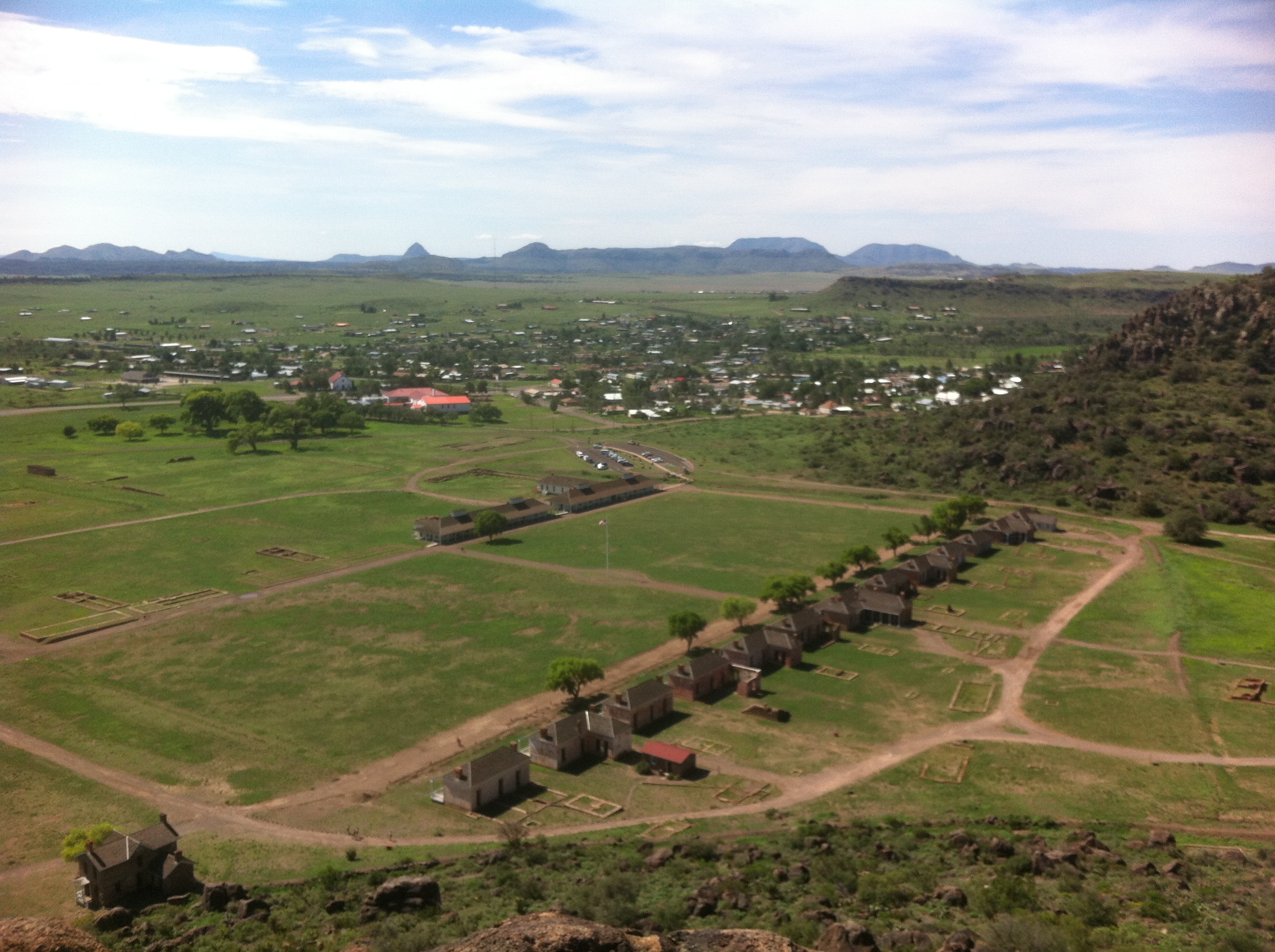
 I finished the first draft of Fort Davis Rocks a week ago, got it to a test reader, and have been making revisions in line with his excellent suggestions. At this point I can’t afford an editor; I will do what has worked in the past. I will get preliminary copies of the final manuscript printed (CreateSpace) and give them to a broader group of friends for comments. I am going to buy cover art.
I have made many improvements to the story in the last week. I find that I get too close to the story at the end, and can’t see the forest for the trees. My friend says it is my best story yet and my dialogue is excellent. I am pumped!
A beautifully written story. I’ve been every step of this trip (twice!) and consider those times to be among my life’s best experiences.
A friend showed me his Colt long barrel .45 caliber revolver yesterday, and I fired it a couple of times. As soon as I saw it, I knew that my motorcycle riding character carries one. The original design was made for the US Army in 1873, and it has been produced for many years. 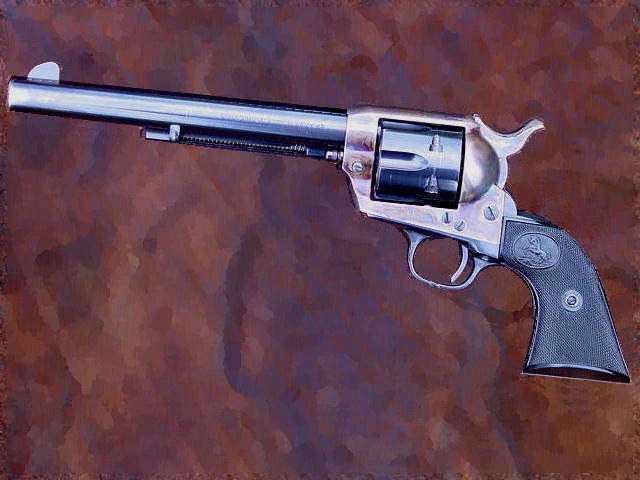
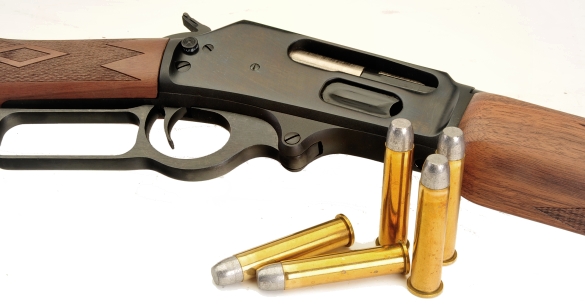
A number of the characters in my story are cowboys, although they don’t think of themselves this way. This particular handgun won the west, although maybe just in the movies. My protagonist owns an old Winchester Model 1895 lever action, which he uses to shoot ‘varmints’ on his ranch. Not that he shoots many, his policy on wildlife is generally live and let live. Anyway, he inherited it from his grandfather. In reading about this recently, I learned that the lead bullet for this rifle has a round nose – a pointed end might fire the cartridge in front of it in the magazine where they are stored. Who knew?
Believe it or not, I am not into guns. I don’t have one in my house for two reasons: I don’t own one, and I don’t need one. I used to have a .22 rifle from when I was a kid, and a shotgun from my brief time shooting birds. I don’t know what happened to them, but I’ve wondered if my kids took them when I was in the process of a divorce. Maybe I was stressed out and depressed. Anyway, we can’t shoot varmints in the City of Fredericksburg, even though there is a gopher in my back yard I would have shot yesterday if I could have. My personal live and let live policy doesn’t extend to gophers, red wasps, flies, mosquitoes, and roaches. Add fire ants to that list.
But this is Texas, and guns fit into the story. Fortunately, I have friends who do know guns – Gordon at KNS Precision, and my buddy Lee Hereford. (Lee is the President of the brewery, and the beer they make is classic, like me and my characters.).
I also had some excellent advice yesterday on a story detail from my good friend and writing group fellow, Ottis Lane. (Ottis is in the pictures doing what he loves, and while your on the Mision website, give them some money). He has 35 years experience in the emergency room in our hospital, and has seen every condition known to modern medicine, including the exact detail I needed.
Research is a lot more fun that writing. And never, ever make a mistake about a firearm.
I have a character who came of age in 1968. He carries a handgun. The particular choice of weapon is one some readers are very interested in. The handguns I remember from that time were the Colt .38 Special with a 4 inch barrel, because that’s what the Air Force trained pilots to shoot with. A guy I knew owned Colt .357 magnum. It looked like this:

It was big and it was heavy and had a hell of a kick, just like the character does.
So now my current project is to listen to the sounds a revolver makes when you pull the hammer back. After consulting with a firearms expert, I learned that there are two sounds – one is the cylinder turning to put the next bullet in line with the barrel, and the other is the hammer locking in position. Tomorrow I am going to meet with a friend and listen closely, very closely, to what those sounds are.
I am hoping the result will be a few words that precisely describe what it feels like when you hear that exact combination of sounds in the dark of night in the middle of nowhere.
Can I do it?
My friend Tom is writing a story which is coming to a dramatic conclusion. The hero has four issues to deal with, each of which is potentially devastating. He feels as if he has been cut off at the knees. Does the story conclude with all the actors gathered in the drawing room, the policeman waiting outside the door, all waiting for the detective to reveal the identity of the murderer? Or does the hero face each issue separately, resolving them one at a time? Tom doesn’t know yet, and this is probably the trickiest part of writing this story. He has great characters – we hate the bad guys and love the good guys. At this point it is looking pretty grim for our hero.
I am at the same point in my story Fort Davis Rocks. My hero is in the hands of the villain and in the very jaws of death. Does he survive, get the girl, and keep the ranch?
My writer friend Robert L Schwarz wrote this story so it would be preserved in some fashion. His writing includes “Out of the Nam” and “R L and other stories.” The first is the story of his experience as a draftee in the army from 1968-1969. The second is a collection of stories from his life in rural Kendall County. Both are available only directly from Robert at this point, but I am trying to change that. I will post short excerpts from both, along with purchase information. Robert’s words are brave and true. His writing is the best I’ve encountered in a very long time.
Clarence Schwarz: The First Wave at Bougainville
By Robert L Schwarz (Nephew)
My uncle, Clarence Schwarz, was in the first wave of the marine amphibious assault on the Japanese held island of Bougainville on 1 November 1943. Once home, he hardly ever spoke of the war or his part in the war except in bits and pieces until the latter years of his life, when he would occasionally and hesitantly speak of the events of that period of his life to his family and most trusted friends. These are his recollections of 1 November 1943 as he related them to me in a one-on-one conversation in the summer of 1983 mixed together with a few other tidbits of information he shared with me on other occasions. I have tried my best to tell his story as he told it to me, using his own words and descriptions other than for some general geographical information from the encyclopedia to establish the setting.
When the United States entered WWII in December 1941, Clarence had just turned 19 years old. He farmed, worked day jobs and helped his mother, Clara Simon Schwarz, run a dairy on Corley Road in southwest Kendall County on Balcones Creek. He and his cousin went to the recruiting offices in the Bexar County Courthouse in downtown San Antonio to enlist in the army since they knew they were going to be called up soon anyway. They arrived there close to noon and the army recruiting office was closed – all the personnel having gone to lunch – but across the hall the navy office was open and one of the naval officers assigned there upon seeing Clarence and his cousin wandering about in the hallway invited them in for some coffee and doughnuts. Long story short – Clarence joined the marines and his cousin joined the navy.
Clarence served with the Third Marine Division in their island hopping campaign in the Pacific. After boot camp his early days as a marine were largely spent in training exercises for amphibious assault operations but, as the marines became more engaged in actual combat operations, Clarence participated in several early small island assaults but always said luck was with him because his unit went ashore in the third or fourth or fifth wave of the assaults rather than in the first.
At Bougainville – a small island 127 miles long and 49 miles wide at the widest point – the northernmost island in the Solomon chain directly east and approximately 500 miles from New Guinea – 900 miles northeast of Australia – Clarence went ashore in the first wave on 1 November 1943 as a part of a 14000 man marine assault on the island. The island was characterized by almost impenetrable jungles; bottomless mangrove swamps; heavy daily torrents of rain; millions of insects, centipedes, lizards, snakes, mosquitoes and rats bigger than house cats with narrow beaches and strongly fortified Japanese concrete bunkers in the treeline by the beaches and beyond.
The men, heavily burdened with their weapons and gear, began loading into LVT’s – landing vehicle transports – at 2:30 AM in pitch darkness with no lights of any type allowed. To get into the landing craft, they had to go over the rail of the 4 or 5 story tall skyscraper sized troop transport ship and crawl down wet and slippery rope cargo nets pitched over the sides.
Clarence not only had his rifle, ammo, and standard gear to include a bayonet, but also carried a 45 caliber pistol which he had bought from a guy at a pre-invasion training site who had been wounded in an earlier island assault and was being shipped stateside. Along with the other marines, Clarence had heard the stories of the night time suicide attacks and thought a light and easy to handle but powerful pistol capable of quickly firing seven rounds would be just the thing to have in close combat situations. By the rules, officers were the only ones authorized to carry 45’s into combat but lots of the guys had them and the command elements simply looked the other way. Clarence carried the pistol in a fabric holster with a snap shut flap on a belt running around his neck and underneath one arm so that the pistol was readily accessible on his chest.
As a tie to his family and life at home, Clarence also carried in one of the compartments of his leather billfold the silver dollar his mother had given him on the day he left home to go into the military with her admonishment to be sure to bring it back home to her. (Grandma Clara Schwarz also gave a silver dollar to her youngest son Elmer who served with the army rangers in Europe after D-Day and did the same for me when I left home in 1968 to go into the army destined for the Nam war.)
The LUT’s were being pitched about by high waves and were crashing into one another and against the hull of the troop transport ship. Some of the men lost their footing and their handholds on the cargo nets and plunged into the water weighed down with all their heavy gear and drowned – others were crushed to death between the hull of the transport ship and the hulls of the LUT’s as they pitched about and their lifeless bodies remained tangled in the nets or disappeared into the dark water. Once the LUT’s were loaded with 20-25 men allotted per craft they pulled away from the transport ship and circled while waiting for the remaining LUT’s to be loaded with troops. The waves tossed the small landing craft about; sea water splashed over the sides; most of the men became violently seasick and the bottom of the landing craft filled to six inches deep with cold sea water, vomit, urine, and feces. The stench was stifling; the men could hardly breathe. They had to stand packed loosely together with all their gear leaning against the sides of the landing craft each other as the landing craft bounced about in the waves. Once loaded, all the LUT’s circled until early dawn and then turned in the semidarkness with the lifting of the naval barrage to make their predetermined runs to the beach.
It was still too dark for the Japanese defenders on the beach to actually see the oncoming landing craft but they could hear them and began to fire out to sea into the darkness with machine guns and rifles spraying bullets about indiscriminately. Clarence’s landing craft as well as many others got hung up on an undetected coral reef and the coxswain had no choice but to drop the ramp. As soon as the ramp splashed down every man in the front was killed outright or wounded by random Japanese machinegun fire from the beach and the men in back had to crawl over the dead and wounded to get out of the craft while the wounded clutched at them crying out to them for help. Two of the most basic rules drilled into them during months of extensive assault training were that no one should stop to help the wounded and no one should comfort the dead no matter who they were – those tasks were to be left to the medics and graves registration personnel. Each and every marine was taught that he had his own specific job to do and he had to concentrate on that job and accomplish his individual mission to the exclusion of everything else. Their training and discipline asserted itself and drove the men out of the landing craft and forward.
They had been repeatedly told in pre-invasion training briefings that when the ramp went down they would be no more than thirty yards from the beach in six inch to one foot deep water – but – when the ramp went down they were in eighty yards from the beach in chest deep water with high waves. Some of the men were washed off their feet and drowned in the surf pulled under by the heavy gear strapped to their bodies from which they could not free themselves. Others were hit by random incoming fire while wading ashore.
Clarence managed to stay on his feet and holding his rifle over his head to keep it at least somewhat dry and operational was able to stumble ashore. Running in the beach sand was impossible – he said it was like trying to move through a huge mass of cooked oatmeal. Once on the beach he sought shelter in a shell hole blown in the sand. He saw multiple dead floating in the surf or lying on the beach rocking gently to and fro with the coming and going of the waves – guys just like him.
His exact words to me forty years later were, “I thought that I would never see the sun rise.”
Clarence could not see the Japanese – dense jungle foliage came almost to the water line – all he could see were flashes of fire here and there. It was obvious the pre-invasion naval bombardment had been largely ineffective in destroying the enemy bunkers on the beach and further inland. Japanese mortar and artillery rounds exploded all around him almost burying him in the sand. Clarence was alone in the semidarkness and he could see only a few guys coming ashore. He was completely exhausted – he said he had never been so tired in his entire life – his legs were shaking uncontrollably. He lay in the sand for several minutes – breathless and worn out – wondering all the while, “What the hell am I gonna do now?” Then he saw other men scattered up and down the beach getting to their feet and moving inland and he thought, “If they can do it, I can do it.” With that thought, he, too, struggled to his feet and pushed forward into the growth and into the Japanese fire. The combined push by individual men who took it upon themselves to move forward and small groups of men – largely isolated and leaderless – their units having been shattered an almost of their equipment lost at sea or destroyed by incoming rounds – forced the Japanese back from the beach making it possible for the following waves of marines to come ashore without losses.
My uncle, Clarence Schwarz, was in the first wave of marines at Bougainville.
Though he went on with his life after his return home from the war, his memories of that day haunted his dreams all the days of his life.
It is important that his recollections of that day’s events not be lost – important to his family and to everyone else, too, as he and many other plain ordinary young men went off to the war, suffered through horrific happenings and endured as best they could then and afterwards.
Do you want to know the actual cost of war – the price paid?
Look once more at the picture of Clarence at the beginning of this story – the strong handsome vibrant smiling open young man in his dress green uniform so proud to be a marine going off to the war in service to his country.
After the war, he hardly ever smiled – there was an aloneness about him hard to describe – a closed off feeling – an ever present intenseness as if he were listening to and looking at something off in the distance – though he remained a hard worker and a disciplined marine – Semper Fidelis – Always Faithful – to the end of his life.
Robert L Schwarz
3 January 2014

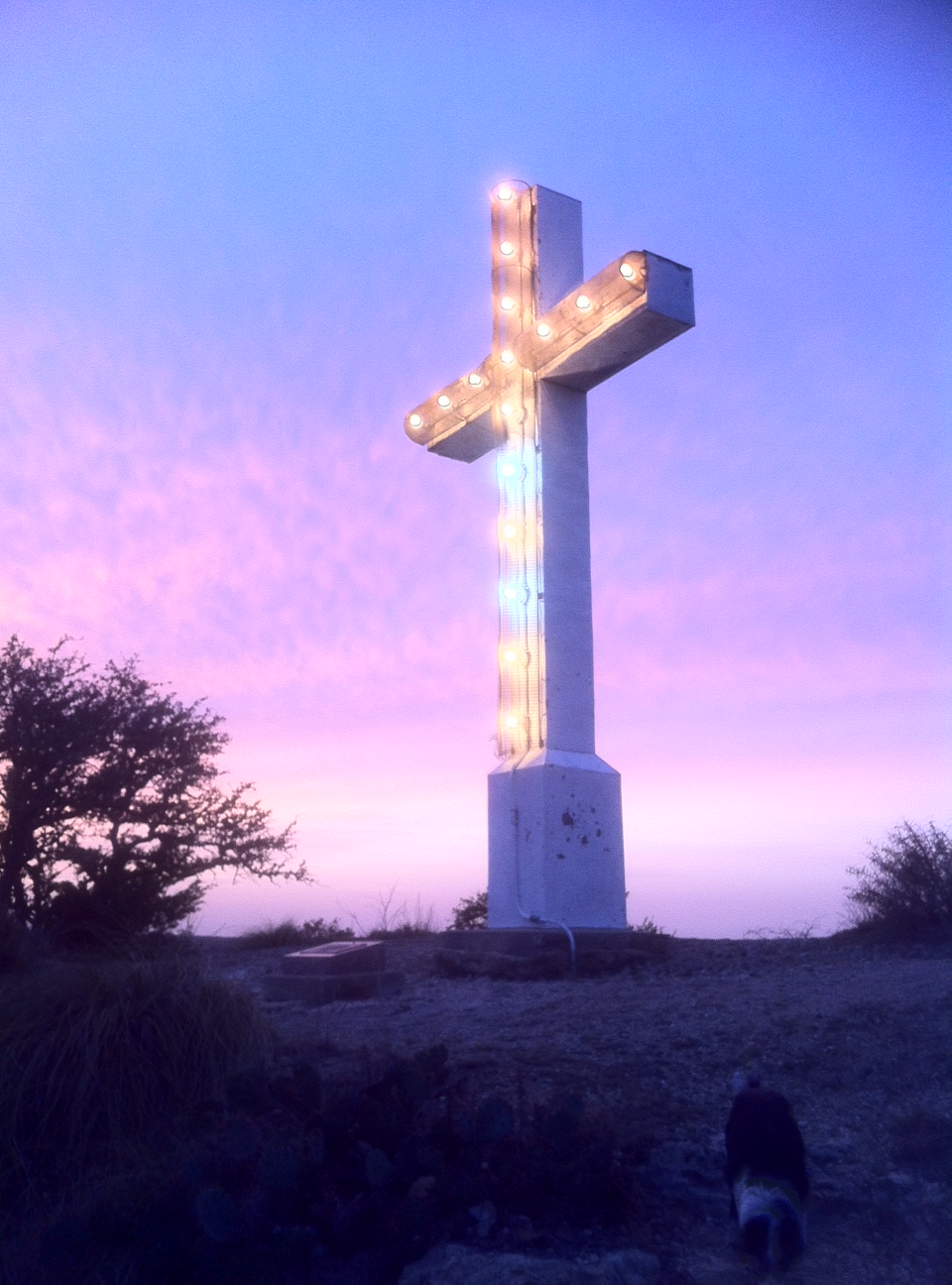
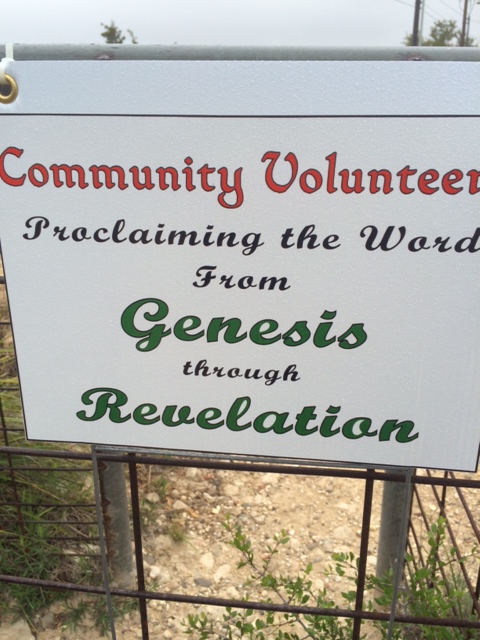
I have a friend from Toastmasters, Sheila who is a professional speaker. In presentations in our club she can hit me right between the eyes in 5 minutes. She got this idea that we would be better off in our smallish city of Fredericksburg, Texas, if we had a project to read the Bible from Genesis through Revelation out loud, in several locations around the city, in the days preceding Easter. She uses a very efficient sign up program to get a lot of people to volunteer to participate. I did this last year, so this time I signed up early to get my favorite spot in town: Cross Mountain. It sits at the north side of the city and is now a park. My border collies poke their noses at me at sunrise and sunset every day, prodding me toward a walk there. The story is that a German pioneer found a wooden cross on the mountain in 1847, presumed to have been erected by the Spanish hundreds of years before. About 40 years ago a local welder fabricated a steel cross on top of the 120 foot tall hill. My assignment was to read Genesis 15-26 on Cross Mountain. I went up the mountain not long after sunrise with a copy of the Bible (RSV) given to me by my father on my 7th birthday. I actually remember receiving it. (I am a preacher’s kid, a PK).
I don’t read the Old Testament much; from my point of view as a (progressive?) Christian, it is not relevant. But I have a lot of friends who have found real value in those ancient books. The story was wild and wooly, including sex, incest, greed, lust, animal sacrifice, people showing up to speak for God (angels?), and real estate transactions. I wondered how much of this story really happened. It was likely passed down in an oral tradition before being written down several thousand years ago in a language now only understood by scholars. A few years ago I read a translation of the Epic of Gilgamesh in a book by Thomas Cahill, which was very difficult to wrap my mind around. Genesis is not like that – the story is easy to understand, the people even seem real, the themes are familiar.
You have to get past the style and the lists of children to begin to get a sense of the story. Now I can see why a screen writer would want to tackle the story of Noah. They are people we can understand engaged in struggles we can appreciate. When I finish my current writing project, maybe I’ll take one of these stories and put it in a modern setting.
Do I believe that what I read this morning really happened? I doubt it, but I don’t care. What interests me is that it was written in a time long, long ago, when the earth was fresh, and civilization was new. What do I care about? The four Gospels later in the volume. The Beatitudes. Matthew 25:36.

Sometimes things come to me in the middle of the night that makes sense. I have been trying to figure out a significant plot detail for a while, and it popped into my head at 2:30 AM. I wonder if I have been too distracted by other events in my life for my subconscious to get it through to my conscious.
When my friend Mara told me 10 years ago that her characters spoke to her, I said she was a little nuts. I had to change my mind about that when my characters started talking to me. Now I just say that we are all a little nuts. She is planning to release her latest romance/thriller on April 15th and is asking lots of people to buy it on Kindle that day to make a splash. Mara and I formed the Fredericksburg Writers Conference a year ago; she has the ideas, I know how to make them happen, and it has been quite a success.
Perhaps, now that I know how this story gets to a major scene, I can get on with business.
Right on, sister!

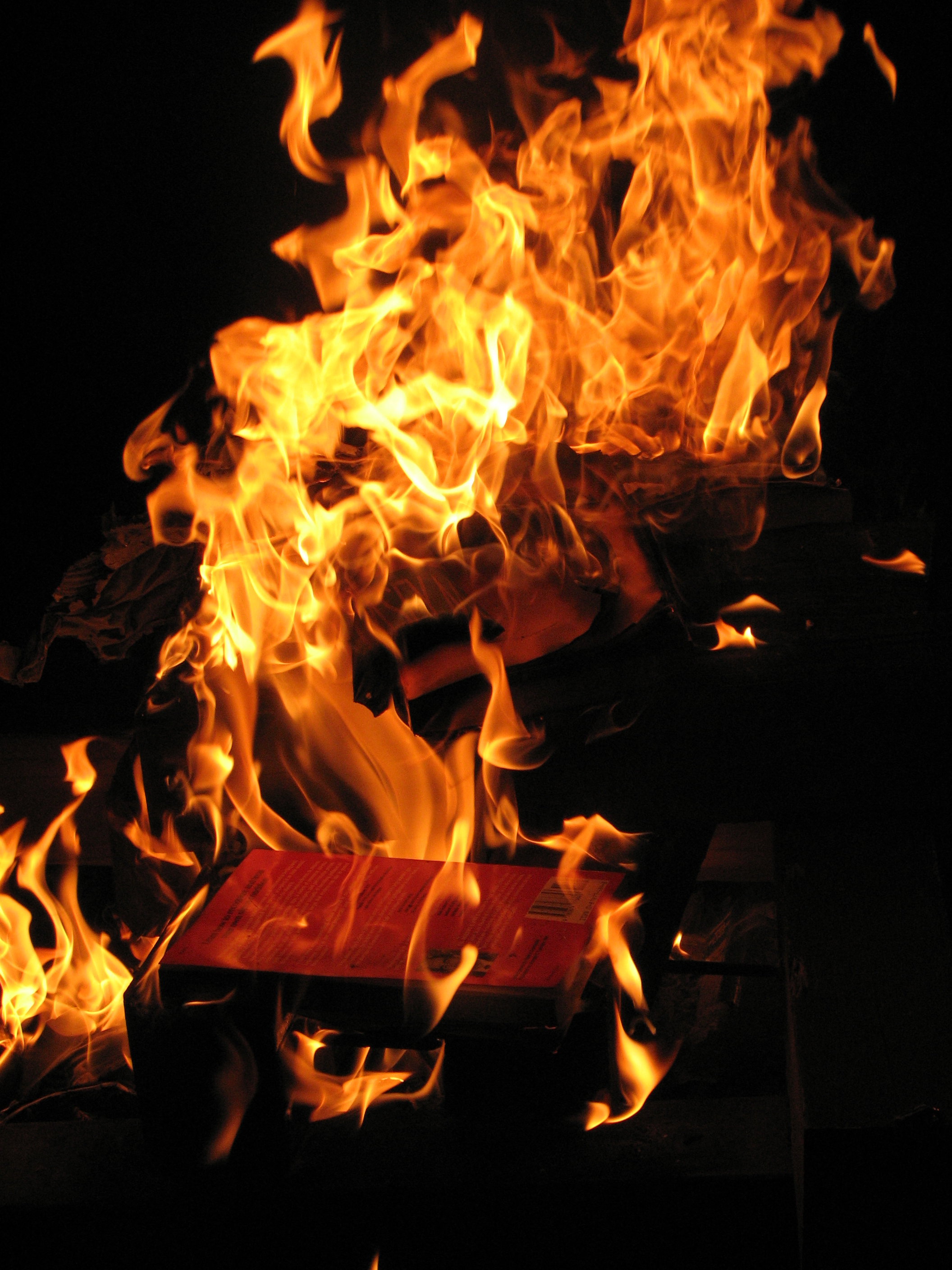 It was close to this. Good thing digital files don’t burn well.
Last week, I had something I haven’t had for a long time: I had writer’s block.
I didn’t know what it was. I was just staring at the screen like I was staring into Nietzsche’s abyss, except that while it might have been staring back at me, it sure as hell wasn’t saying anything. Everything I tried seemed like shit. Even the stuff I’d written the day or the week before seemed like shit. There was, in fact, a lot of shit around, and it seemed like I was responsible for creating most of it.
I was close to deleting a lot of it. The last chapter, for sure. And I did in fact throw about 10,000 words—about 40 pages, if you prefer to calculate that way—into the wood chipper I call The Purgatory File. It’s where stuff…
View original post 375 more words
Here’s the last paragraph of Fort Davis Rocks:
Betty was already at her desk when Delbert arrived. “You get enough sleep last night?”
Delbert stopped at her desk and looked at her. “Coffee?”
“Already made. Get it yourself.”
“Thank God.”
“Rough night? You look rode hard and put up wet.”
“Don’t know that I got much sleep.”
“Rowdy campers?”
“In a manner of speaking.”
“Oh, her.” Delbert didn’t say anything. “You don’t have to tell me. I’ll hear about it soon enough. The dispatcher will be calling soon with the Delbert Report.”
“My life is turning into a soap opera.”
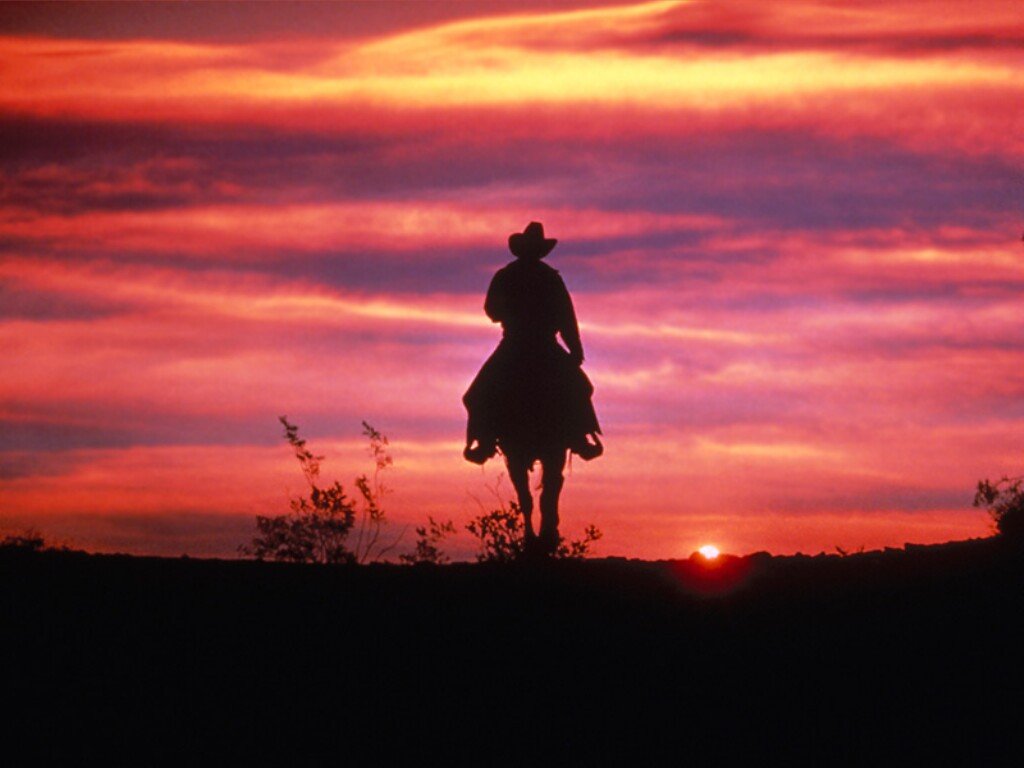
This is what Delbert looks like when he isn’t working at the park. This picture is from a very cool magazine which seems to know cowboys.
 robertcdeming